PLA vs PETG vs ABS: Which 3D Printing Material Should You Choose?
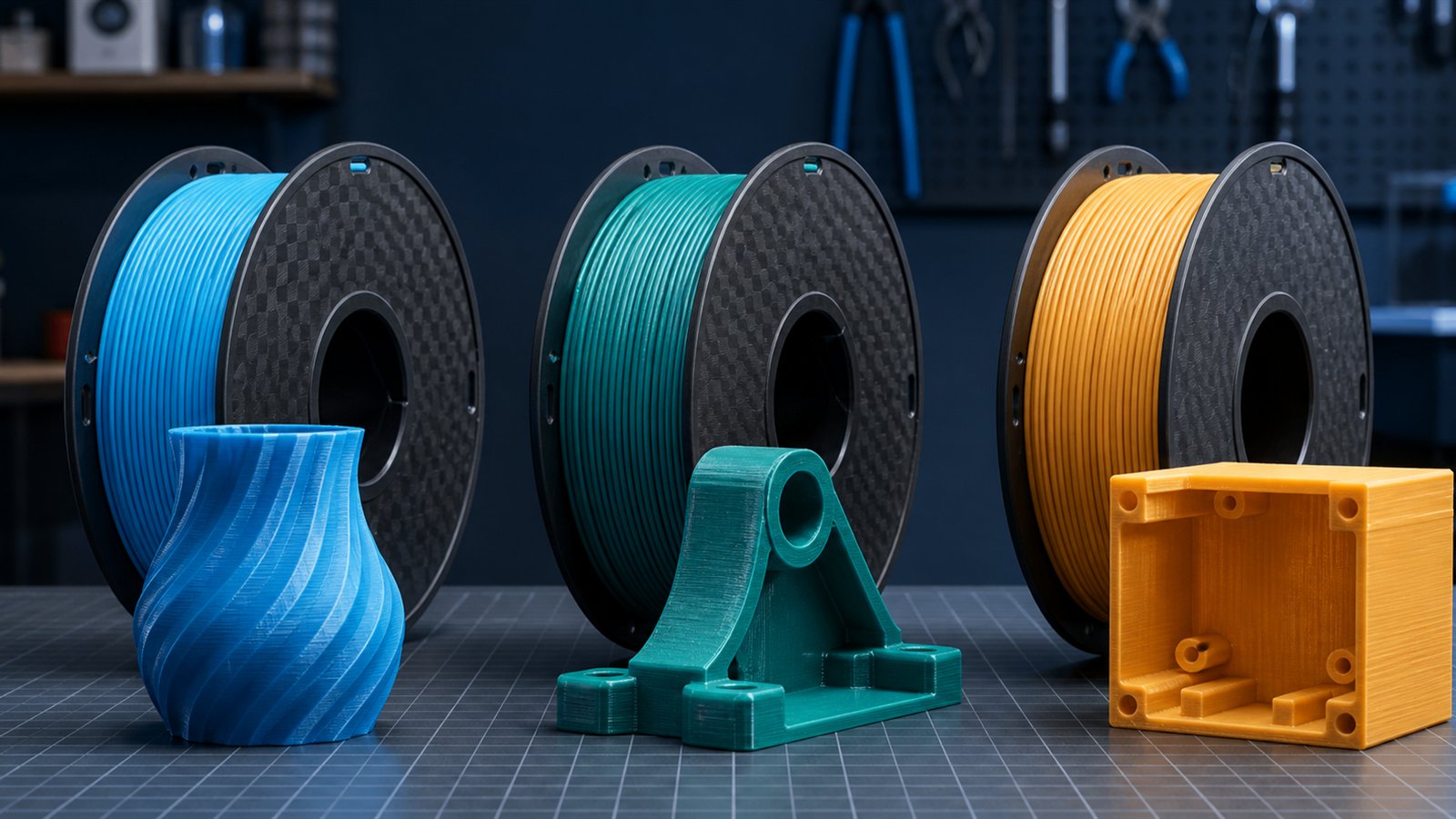
Short answer: choose PLA for many detailed visual models and indoor prototypes, PETG for many tougher functional parts and moisture-exposed applications, and ABS when higher heat resistance or specific post-processing is important. The correct choice still depends on the exact material grade, geometry, load, temperature, and finish.
There is no single “best” 3D printing material. A good material is one that matches where the part will be used and what it must do.
PLA: a practical choice for visual models
PLA commonly produces clean detail with relatively low warping. It is often a useful starting point for concept models, figures, educational objects, presentation pieces, and indoor parts that will not face high heat or repeated impact.
Its main limitation is the environment. PLA is not the default choice for a part that will stay in a hot vehicle, near a heat source, or outdoors for long periods. It can also behave more rigidly and fracture differently from tougher materials.
Consider PLA when:
- appearance and fine detail are more important than heat resistance;
- the part is an indoor concept or presentation model;
- you need an early prototype to check shape or fit;
- the part will not carry a critical load.
PETG: a balanced option for functional parts
PETG is commonly selected when a part needs more toughness, good layer adhesion, and better moisture tolerance than a typical PLA print. It can suit holders, clamps, enclosures, organisers, and other functional parts.
The trade-offs include possible stringing, less crisp behaviour on some tiny details, and more difficult support removal. Moisture resistance of the raw material also does not guarantee that every printed container will be watertight; geometry, walls, layer bonding, and testing still matter.
Consider PETG when:
- the part needs a balance of toughness and printability;
- it may encounter humidity or occasional water exposure;
- it is a functional holder, cover, clamp, or enclosure;
- slight flexibility is preferable to brittle failure.
ABS: useful where heat and post-processing matter
ABS can provide better heat resistance and good toughness for many engineering applications. It can also support sanding, gluing, and controlled acetone smoothing.
Printing ABS requires a controlled process because shrinkage can cause warping. Proper enclosure and ventilation are important during manufacture, and its resistance to long outdoor UV exposure is not automatically ideal.
Consider ABS when:
- the part will face more heat than PLA should handle;
- mechanical toughness is important;
- the design and dimensions account for material shrinkage;
- a specific ABS-compatible finish is required.
Material choice for Egypt’s climate
Tell the printing service if the part will stay inside a parked car, on a sunny balcony, near a motor or power supply, or in a humid location. “Indoor” and “outdoor” are not detailed enough for an engineering decision. Include the likely temperature, duration of exposure, expected load, and whether failure could cause damage or injury.
Material names also describe families, not identical products. Colours, additives, suppliers, and print settings can change performance. For a functional or safety-relevant part, validate the actual printed sample under realistic conditions.
A quick decision process
- Define whether the part is visual, functional, or both.
- Describe the expected heat, sunlight, moisture, impact, and load.
- Identify the most important dimension or fit requirement.
- Choose the required surface and finishing level.
- Review the active material options and compare the estimate.
- Test a prototype before ordering a large quantity.
You can upload your model and compare active material options. Read the 3D printing cost guide to understand how material choice affects the estimate.
Important safety note
A standard FDM print is not automatically approved for food contact, medical use, pressure, electrical insulation, or safety-critical loads. Material composition is only one part of the assessment; the nozzle, additives, layer grooves, geometry, process, and applicable standards also matter.
Frequently asked questions
Is PLA or PETG better for a prototype?
PLA is often suitable for a visual or fit-check prototype. PETG may be a better starting point when the prototype also needs toughness, moisture tolerance, or repeated handling.
Is PETG waterproof?
The material resists moisture, but a printed part is not automatically watertight. Walls, layer bonding, openings, geometry, and testing determine the result.
Is ABS always stronger than PLA?
No single comparison applies to every load and design. Material grade, wall layout, layer direction, geometry, and print settings can change how a part fails.
Which material is best for a part left in a car?
Heat resistance becomes a critical requirement. Provide the expected conditions and avoid selecting PLA by default without validation.
Are 3D printed parts automatically food-safe?
No. The filament name alone is not enough to establish food-contact suitability. The complete material and manufacturing process must be assessed.